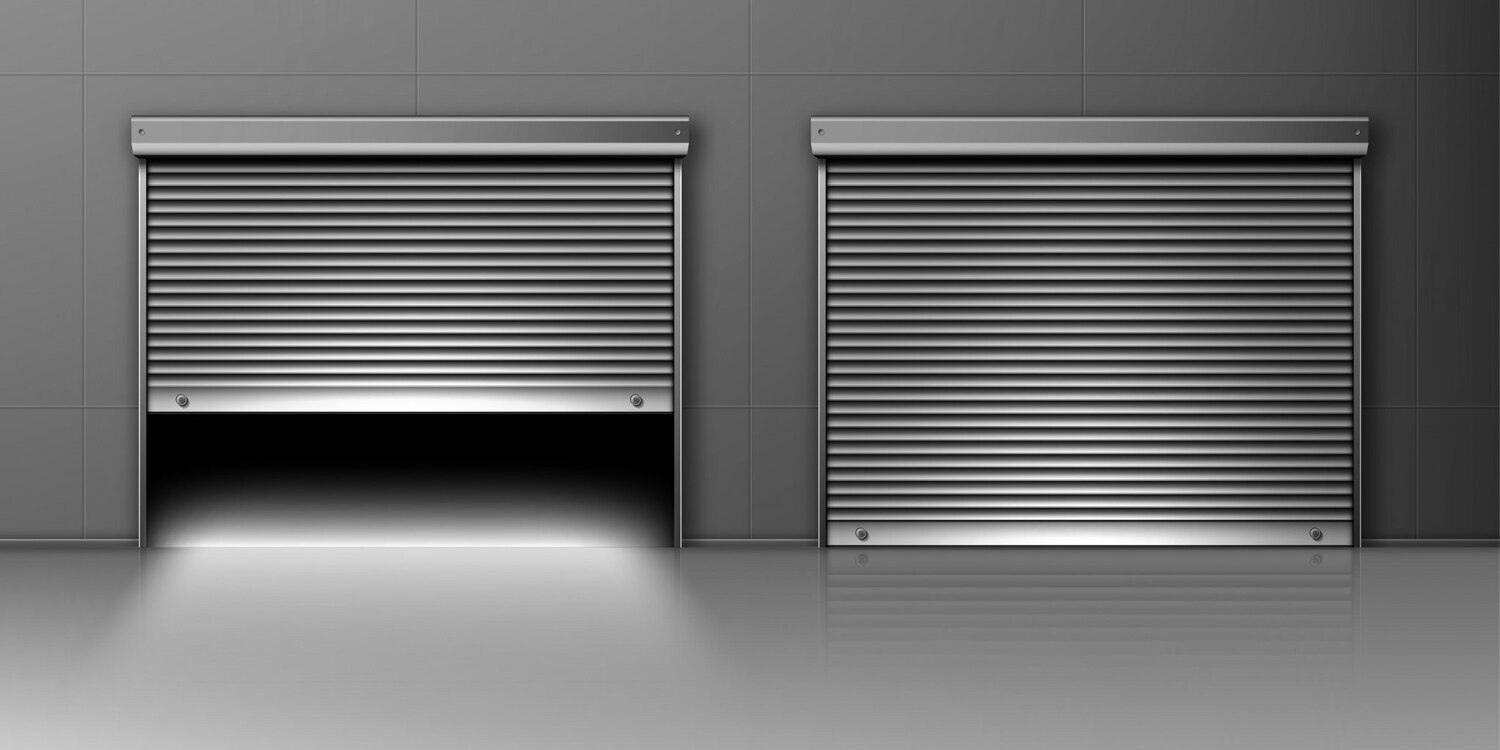
A rolling shutter must be designed as a complete assembly, not ordered as a sheet-metal curtain alone. By the end, you will know which opening measurements to provide, how the curtain and drive are built, how face-fixed and reveal-fixed fitting differ, and which checks prevent an unsafe or poorly balanced installation.
Key takeaways
- Measure width, height, diagonals and headroom at several points.
- Inspect curtain links, end locks, barrel supports and welds before fitting.
- Select the barrel, spring balance and drive for the curtain’s actual load.
- Install guides, curtain, barrel and controls in a fixed sequence.
Survey the Opening Before Any Steel Is Cut
Measure the opening at several points before steel rolling shutter fabrication and installation are specified. A single nominal width can hide a tapered masonry opening, an uneven shopfront frame or a misplaced structural column; forcing the guides into that error produces binding and premature wear.
1. Record the clear width at the top, middle and floor, then record the clear height at both jambs and the centre. Note the smallest measurements, not the average.
2. Check whether each jamb is plumb, the lintel is level and the opening is square. Measure both diagonals; unequal diagonals identify a distorted opening that needs correction or a deliberate fabrication allowance.
3. Measure headroom for the barrel, end plates and hood or fascia. Record side room for the guide channels, including space for fasteners and any obstruction from beams, pipes, wiring or signage.
4. Identify the fixing substrate at every guide and end-plate position: reinforced concrete, brickwork, blockwork, structural steel or shopfront framing. Check its thickness, soundness and available embedment; loose masonry cannot hold a heavy shutter securely.
5. Confirm floor level, finished-floor height and the position of columns or walls carrying the guides. Record the opening width, height and exposure needed to select the curtain profile, guide size and wind class under EN 12424.
Include the barrel, bottom rail, guides, hood, drive, controls and safety devices in the survey scope. Omitting one component creates dimensional or compatibility problems after fabrication has begun.
Build and Inspect the Curtain Assembly
Steel sheet becomes a usable curtain through controlled forming, not by simply cutting panels to size. The steel rolling shutter manufacturing process starts by selecting the gauge, galvanized or painted finish, and lath profile for the opening width, security requirement, weight, and wind exposure.
Roll-forming machines shape the sheet into interlocking laths with consistent curves and edges.
- Cut laths to the finished curtain width, allowing for the guide channels and end locks.
- Join successive laths through their formed interlocks, keeping the curtain straight and free from crushed joints.
- Fit end locks at the lath ends to prevent sideways movement and reduce the risk of the curtain walking out of the guides.
- Form and attach the bottom rail, then add its sealing strip or protection edge where specified.
- Assemble the curtain around the barrel, checking that the rolling diameter and winding direction match the drive arrangement.
The fabricator then checks the curtain as a complete assembly rather than approving the steel gauge alone. Inspect the lath joints, end locks, bottom rail, barrel brackets, guides, hood or fascia, and fixing points for correct alignment and compatible dimensions.
The curtain must travel without binding, excessive noise, or uneven gaps; a heavy section rubbing one guide indicates a fabrication or alignment fault.
Record the curtain width, height, mass, profile, coating, and specified wind class. Wind resistance depends on the installed curtain, guides, restraints, and supporting structure—not sheet thickness in isolation.
Size the Barrel, Balance and Drive to the Actual Load
The barrel diameter and drive torque must match the installed curtain, not a nominal “heavy-duty” label. Calculate the curtain mass from its steel gauge, lath profile, width and height, then add guide friction, bottom-rail weight and the resistance created by the spring balance.
A wider or wind-exposed opening can require stronger guides, wind locks or intermediate supports, which also increase the load.
Select the operating method against load, opening size and daily cycles:
- Manual pull operation suits small, lightly used shutters that a person can raise without excessive force. Incorrect spring tension makes the curtain rise suddenly or drop unexpectedly.
- Gear-operated shutters suit larger curtains where a hand chain reduces lifting effort. Match the gearbox ratio and chain position to the barrel load, available headroom and operator reach.
- Motorised shutters suit frequent use, wide openings or controlled access. Size the motor for starting torque, friction and the required duty cycle; a motor that lifts the static curtain can still overheat during repeated shop traffic.
Spring-balanced shutters need adjustment after the curtain is fitted. Balance reduces drive torque, but it cannot compensate for undersized guides, a bent barrel or badly set limits. Specify controlled stopping, emergency release, bottom-edge protection and safety devices with the motor.
The steel rolling shutter manufacturing process must cover the complete system: barrel, end plates, hood, guides, drive and controls as well as the curtain. Record the calculated load, barrel size, balance setting, limit positions and duty rating, and check the selection against EN 13241 and the project jurisdiction’s adopted requirements.
Fit the Guides, Curtain and Controls in the Correct Sequence
Steel rolling shutter installation starts with the guides, not the motor. Confirm the opening is clear, the fixing substrate is sound, and the floor and lintel lines are marked before lifting any assembly into place.
1. Fix the guide channels to the prepared walls, columns, or frame. Set both guides plumb, parallel, and at the specified spacing; do not pull them into alignment with excessive force, because the curtain will bind.
2. Assemble the barrel, end plates, spring balance or drive, and hood or fascia. Check that the barrel is level and that its bearings, brackets, and fixings carry the actual curtain load.
3. Feed the curtain into both guides while supporting its weight. Attach the top curtain section to the barrel, fit the bottom rail and end locks, then rotate the barrel by hand to confirm smooth winding without rubbing.
4. Adjust the spring balance after the curtain is fully installed. A poorly balanced curtain increases motor torque and can cause an uncontrolled rise or descent; correct balance does not excuse undersized guides or an incorrectly selected drive.
5. Connect controls only after isolating the electrical supply. Set open and close travel limits with the curtain aligned, then test stopping controls, emergency release, manual override, and every fitted safety edge, photocell, or interlock under load.
Commissioning is incomplete until the shutter stops at the sill without crushing it and closes without leaving a head gap. Record limit settings, electrical details, safety-test results, release instructions, and maintenance checks for guides, fasteners, curtain damage, noise, balance, cables, and controls. Never keep operating a shutter with a failed safety device.
Match the Curtain and Mounting Method to the Opening
A face-fixed shutter suits a shopfront or retrofit; a reveal-fixed shutter suits a prepared opening where preserving wall space and a neat fit matter. Choose the curtain and fixing arrangement together.
| Opening | Curtain construction | Mounting and fixing | When it applies |
|---|---|---|---|
| Shopfront | Solid laths for privacy and weather screening; perforated laths for visibility and ventilation | Face-fixed guides and hood over the opening | Use solid steel rolling shutters for shops needing concealment after closing; choose perforated sections only when exposure of merchandise is acceptable |
| Warehouse | Heavier lath profile with end locks, reinforced guides and specified wind resistance | Face-fixed guides anchored to structural masonry or steel; add intermediate restraint where required | Use this arrangement for wide openings and exposed elevations; tie the specification to the EN 12424 wind-load class, not steel gauge alone |
| Internal partition | Lighter solid curtain where separation and security matter, with no unnecessary wind hardware | Reveal-fixed guides inside the framed opening | Use it between factory bays, storage areas or service zones when the surrounding frame is plumb and strong |
Face fixing tolerates limited reveal depth and covers irregular masonry, but it reduces the visible opening and needs sound wall anchors. Reveal fixing looks cleaner and preserves the surrounding wall, yet an out-of-square frame will force the guides out of parallel and cause binding.
Give Modak Enterprises the survey dimensions and require the quotation to name the curtain, guides, hood, barrel, drive and safety controls; omitting any of these turns steel rolling shutter installation into a site compatibility problem. A spring-balanced curtain still needs adjustment after fitting.
Related products
 | ROLLING SHUTTER Modak Enterprises Modak Enterprises manufactures and supplies Steel Rolling Shutters in Nashik, India, offering strong, durable, and high-security... View product → |
 | ROLLING SHUTTER ME- 501 INDUSTRIAL ROLLING SHUTTER CURTAIN : Constructed using 115*0.9mm/115*1.20mm Galvanized sheet. View product → |
Frequently asked questions
What must you measure before steel rolling shutter fabrication?
Measure the opening width, height, diagonals, headroom and side clearances at several points. Check for tapered masonry, uneven frames and structural obstructions before cutting steel.
What should you inspect in a rolling shutter curtain assembly?
Inspect the curtain links, slats, end locks, bottom rail, welds and barrel connections. Confirm that the assembly moves freely and has no distorted or sharp components.
How do you size the barrel, balance and drive?
Base the barrel, spring balance and motor or chain drive on the curtain’s actual weight, width, height and operating frequency. Do not select components from opening width alone.
What is the correct steel rolling shutter installation sequence?
Secure and align the guides first, install the barrel and supports, attach and centre the curtain, fit the bottom rail, then connect controls and test travel.
Related products
 | Shutters ₹220 We design and fabricate manual, gear-operated, and automatic rolling shutters using premium-grade materials to ensure long service life and reliable... View product → |
 | ROLLING SHUTTER Modak Enterprises manufactures and installs Industrial Rolling Shutters in Nashik, India, designed for heavy-duty performance, high security, and... View product → |
Keywords